
The World Cup of the Future: China-USA 3-2. The AI Match That Changed History

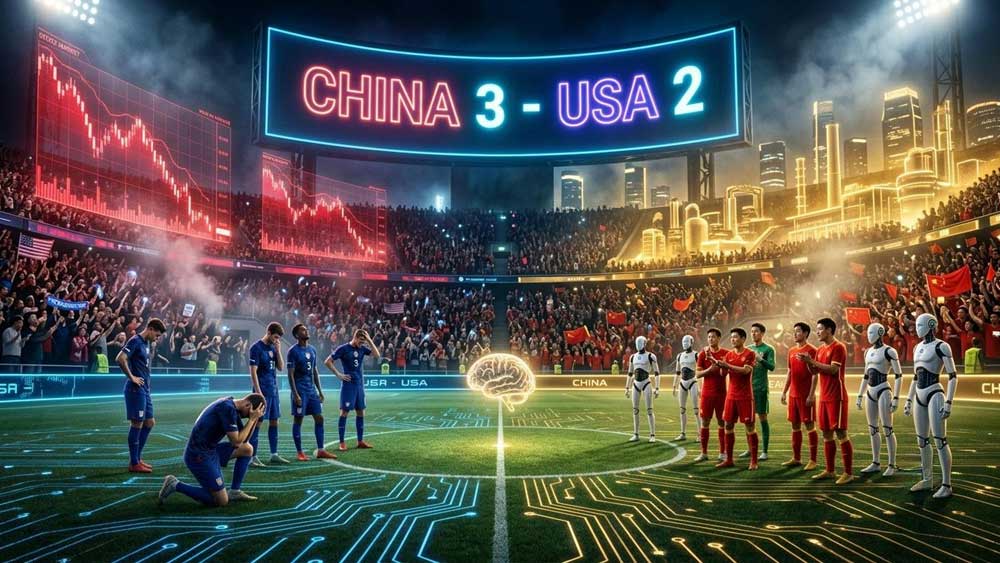
Welcome to the largest stadium in the world. The pitch is the global economy, the ball is Artificial Intelligence, and the final of the century has just entered its most crucial moment. On one side, the United States; on the other, China. Two teams, two jerseys, but above all, two diametrically opposed philosophies on how to imagine the industry and the world of tomorrow.
At the opening whistle, the bookmakers favored the USA. The American team took the field with an undeniable tactical advantage: real innovation backed by a muscular system, oriented toward a future profit as clear on the stock exchanges as it was nebulous in its practical sustainability.
A true "wow" moment, capable of generating enormous financial returns and justifying sci-fi-level models, fueled by staggering infrastructure investments.
The first half: the USA's marketing goal
The first big play is all stars and stripes. OpenAI receives the ball in the attacking third, plays the card of absolute novelty and enveloping marketing. It's a pure spectacle move: it dribbles past skepticism, beats the defensive line of regulators, and slots home a brilliant goal.
1-0 for the USA. Wall Street explodes, the crowd is on its feet. It looks like the one-sided match predicted on the eve.
But China, it must be remembered, is not a team intimidated by fireworks. Strong in its millennial history, it knows how to play the long game.
While the USA celebrates, China studies its opponent. It doesn't seek direct confrontation, it doesn't try to imitate the spectacular play. It does what David did to Goliath: it identifies the weak spot.
And the weak spot of the American giant is the cost model. The USA was burning capital to create maximum financial value, treating AI like a commodity to be placed on the stock market at any price.
The Chinese counterattack: DeepSeek and the equalizer
Start of the year. China restarts from its own half. The move is lightning-fast, a surprise. DeepSeek races toward the penalty area with a single idea: cut costs to do, apparently, the same things. The shot is crisp, unstoppable.
1-1. The goal sends a chill through the press box: the USA had been doping. They weren't looking for efficiency, but capitalization. The equalizer puts the match back in question, even if possession still seems to lean in the American direction.
In the locker room: the vision of the Smart Factory
What the USA hadn't calculated is that the attempt to block China (the infamous embargo on chips and knowledge) didn't stop it, but united it. The entire Chinese system took that direction, integrating into a clear, simple, and unified tactic: build the industrial market of the future from the ground up.
The two teams have opposite visions of the future. The USA wants to build Blade Runner-style scenarios; China wants to build the "Smart Factory of the World," capable of creating value today, improving citizens' lives, and cutting costs.
Deng Xiaoping's motto returns to the pitch: it doesn't matter if the cat is black or white, so long as it catches mice.
Chinese proposals are less flashy on paper, but practical, cheap, and devastating. While the USA distracted itself watching the money, China started rolling out humanoids: no longer just factory robots, but operational companions at every level, worthy of the best RoboCop movies.
It's the era of Phygital AI, and China, already the factory of the world, knows exactly how to dominate it.
The second half: the USA's tactical foul and the Kimi 3 response
At 1-1, the USA tries a dirty stretch. They create an organization (Pax Silica) to "cut off the water" to the Chinese cause and play the card of political blackmail (tariffs) to lock in Western countries.
They attack the rules, anyone's rules, to have a blank check and see the financial returns of the trillions of SpaceX, Anthropic, and OpenAI paid off.
But you never play without reckoning with the host.
China responds to American triumphalism with an impressive evolution of open-source models.
The move ends at the feet of Kimi 3, who presents himself in front of goal and, with a technicality that equals the presumed American champions, slots home the 2-2.
Meanwhile, the USA players (see Mythos and Fable) are so busy predicting Armageddons and arguing with the referee that they risk an own goal, effectively excluding themselves from the competition.
The decisive goal: Xi's vision in Shanghai
It's mid-July 2026. The other day, at WAIC in Shanghai, the captain and president Xi Jinping took the ball of destiny. He looked at the world and announced that China wants AI to be a good of humanity, open to all.
Something that improves everyone's life, not a weapon to enrich a few.
A power goal, based on a vision of the world that grows by sharing.
3-2 for China. A blow that stunned the Americans.
Because now the idea of cutting costs and sharing has been endorsed by no fewer than 29 nations (World AI Cooperation Organization - WAICO).
Not the teams of the rich West, the American coach would object, but the emerging countries: the future world champions, those where poverty is turning into proud wealth and where AI is becoming the new industrial revolution to build a better future.
Stoppage time: the US financial collapse and the European stands
The USA, with a president on the bench who seems to only look at what glitters, appears adrift. They are realizing that the debts created to finance something enormous (but which the Chinese have demonstrated isn't needed to do what really needs to be done) risk drowning them.
The latest news is a disastrous medical bulletin: yields on SpaceX debt downgraded to junk, the listings of Anthropic and OpenAI canceled.
And from the VIP stands, Europe – specialist in regulation and rule-making – is savoring an unexpected pleasure.
European regulators are realizing they no longer want to depend on American whims on such strategic issues. They no longer look unfavorably on the idea of seeing the USA defeated in the competition with China, to finally create an autonomous position, valuing existing competencies instead of seeing them sucked into the American dream of venture capital.
The final whistle hasn't blown yet, the match is still long. But that Chinese one-two has rattled the USA, who now seriously risk ending up with a fistful of flies... paid at a dear price. Get comfortable and buy the popcorn: the second half promises sparks, but the change of pace is already written on the scoreboard.