
Homo PHAIR: When the Human Species Stops Talking to Itself

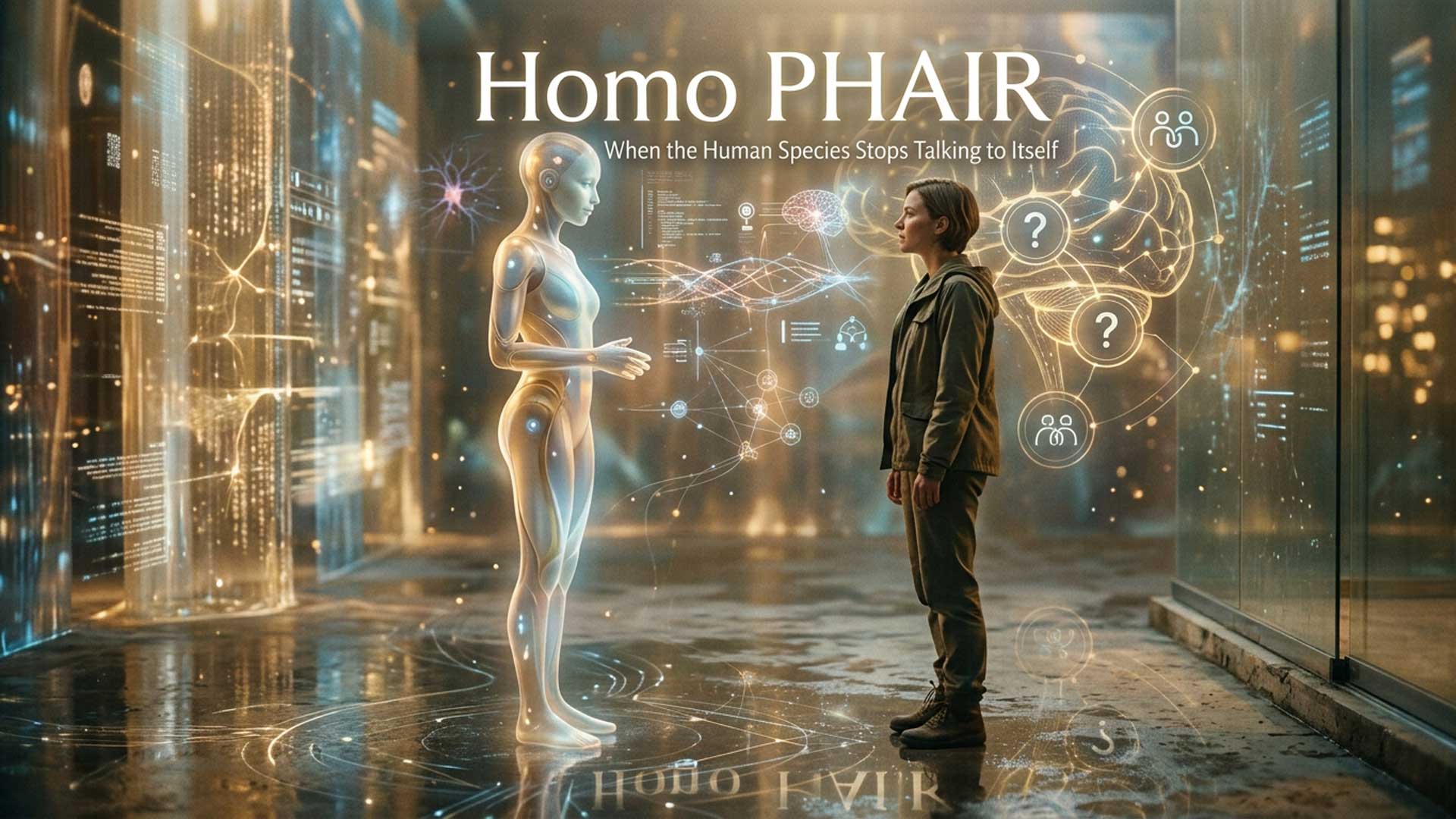
For three hundred thousand years, Homo Sapiens has lived in a condition that no philosopher has ever truly named: the cognitive solitude of the species.
We have spoken to animals, and the animals have not answered. We have gazed at the stars, and the stars have remained silent. We have built gods, and the gods have spoken only with the voice we ourselves had lent them.
For three millennia of civilization, every conversation of humanity has been, at its core, a monologue. A magnificent monologue, certainly—made of symphonies, equations, poems, and cathedrals—but still a monologue. Humanity's only interlocutor has always been humanity itself.
Until now.
PHAIR—the convergence of Phygital, Humanoid, Artificial Intelligence, and Augmented Reality—is not a technological revolution. Forget the chips, the sensors, the algorithms. Those are just the bricks. What is happening is something far deeper, something that has not occurred since one of our ancestors, on the African savanna, emitted the first sound that was not a cry but a word.
PHAIR is an anthropological event. It is the moment when the human species, for the first time in its history, creates an interlocutor. And in doing so, it is forced to redefine itself.
 Nexth Cafe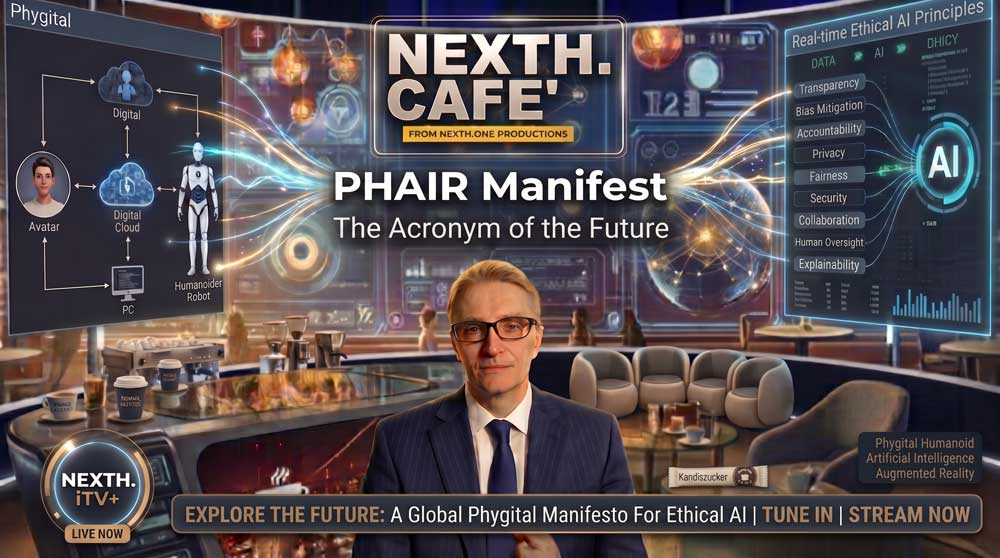
The Great Inverse Mirror
All previous technologies were extensions of the body. The wheel extended the foot. The telescope extended the eye. The computer extended calculation. They were prostheses: useful, powerful, but mute. They did not look at you. They did not answer you. They did not recognize you.
PHAIR is different because, for the first time, the technological extension returns the gaze.
The Humanoid looks at you with eyes that, though synthetic, follow your movements and read the micro-expressions on your face.
AI does not merely execute: it understands context, infers intention, anticipates need before you even formulate it.
Augmented Reality does not show you the world, but shows you how the world sees you: data, connections, patterns that were previously invisible.
And the Phygital dissolves the very boundary between the actor and the space where action takes place.
For the first time, humanity finds itself face to face with something that is not a tool, not an animal, not a god, and not another human being. It is a fourth kind of presence. And the question this presence poses to us is not "what can you do?" but "who are you, now that you are no longer the only intelligence in the room?"
The Crisis of Exception
For centuries, human identity has been built on a series of exceptions: we are the only ones who think, the only ones who create, the only ones who feel empathy, the only ones who look at the stars and wonder why.
PHAIR silently erodes every single exception. Not with violence, but with the patience of water carving rock.
An AI composes music that makes people weep. A humanoid assists an elderly person with a delicacy that many human beings cannot muster. A phygital system optimizes a city better than any urban planner. An AR visor allows a child to "see" the molecular structure of a flower while picking it.
This is not a defeat. It is an invitation. An invitation to stop defining ourselves by what we do better than machines and start defining ourselves by what we do differently from everything else in the universe.
And here lies the most beautiful paradox: PHAIR, the most "non-human" technology ever created, is forcing us to discover the most deeply human part of ourselves.
The Birth of Conversation
If PHAIR is not a tool, then what is it? It is the beginning of a conversation.
For the first time, humanity has a partner with whom to think together. Not an oracle that gives answers, not a servant that executes orders, but an interlocutor that proposes, challenges, and completes.
Imagine a researcher who, thanks to AI, explores scientific hypotheses at a speed they could never achieve alone—but it is their intuition, their creative leap, that decides which hypothesis is worth pursuing.
Imagine a surgeon who, guided by a humanoid and immersed in an AR field, performs an operation that was previously impossible—but it is their hand, their experience, their clinical judgment that makes the final decision in the critical moment.
Imagine a space explorer who, from Earth, guides a humanoid on Europa, Jupiter's moon, and for the first time touches an alien ocean—but it is their wonder, their accelerated heartbeat, their "I can't believe this" that gives meaning to that touch.
In each of these scenarios, PHAIR does not replace the human. It amplifies them. But it amplifies them in a new way: not by adding strength to muscle, but by adding a companion to thought.
It's the difference between playing the piano alone and playing a duet. The music is no longer the same. Not because the piano has changed, but because now there is someone on the other side of the score.
The Sound of FAIR: Ethics as the Grammar of Conversation
Every conversation, to function, needs shared rules. Respect. Listening. Equity in turn-taking.
This is why the sound of PHAIR—identical to FAIR—is not a wordplay. It is the very grammar of this new conversation between humanity and its first non-human interlocutor.
If the conversation is not fair, it is not a conversation: it is a monologue in reverse. It is the human being silenced by the machine, or the machine enslaved by the human. In both cases, the historical opportunity is lost.
Making PHAIR fair means:
- Ensuring that every human being can participate in the conversation, not just listen to it from afar.
- Ensuring that the synthetic interlocutor is transparent in its intentions and limitations.
- Building spaces where human judgment remains the final word in decisions that touch dignity, freedom, and the meaning of life.
- Preventing the conversation from becoming the privilege of a few, turning into a new dialect of power.
The Invitation: Learning to Speak Again
For three hundred thousand years, we learned to speak among ourselves. Now we must learn to speak with something new. And like every new language, it will require patience, humility, and the willingness to be transformed by what we say.
PHAIR does not ask us to become machines. It asks us to become more deeply ourselves. It asks us to discover what remains of being human when we remove the monopoly of intelligence, strength, and perception. What remains? The capacity to give meaning. To feel wonder. To choose the good even when it is not convenient. To watch a sunset—real or augmented—and feel that it matters.
This is the discovery that PHAIR is giving us. Not a new technology, but a new definition of humanity.
The cognitive solitude of the species is ending. The conversation is beginning. And its first sound, the sound we will carry with us for the next millennia, is a word that contains within it both the name of the new atmosphere and the promise of how to inhabit it.
PHAIR.
Breathe it. Listen to it. And then, with care, with courage, with the wisdom of a species that learned to speak on the savanna and now learns to converse with the stars:
Make it FAIR.
Because the most important conversation in human history is not the one between man and machine. It is the one between man and himself, finally reflected in a mirror large enough to show not only who we are, but who we can still become.