
XI plays his cards

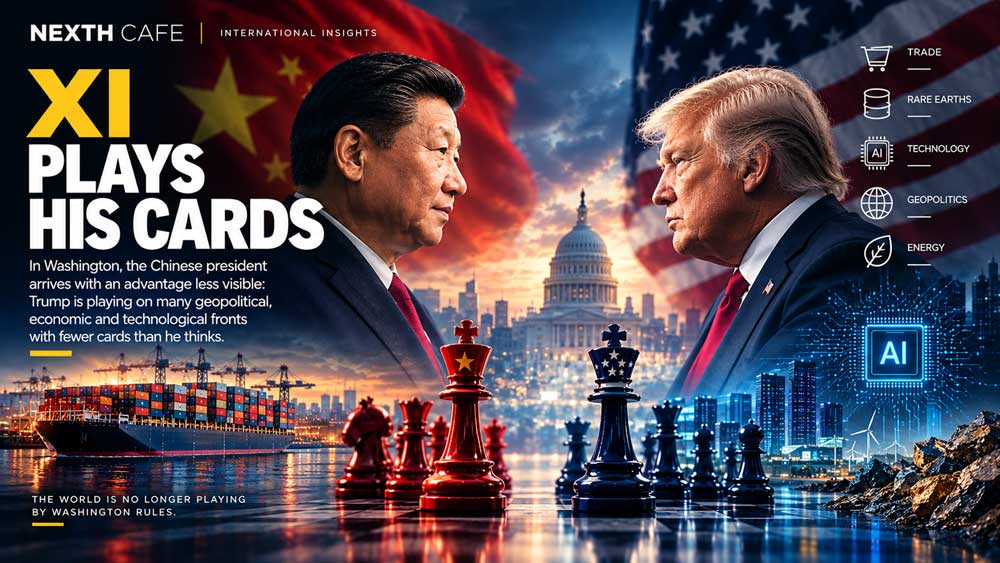
In Washington, the Chinese president arrives with a less obvious advantage: many of the games Trump wants to play no longer depend on the United States alone
To understand Xi Jinping's visit to Washington, it may help to start with the wrong question.
Not to ask what Trump will manage to get from Xi.
But to ask how many cards Trump still has left to put on the table.
On September 24, the Chinese president will be at the White House for a state visit arriving at a particularly delicate moment in relations between the world's two largest economic and technological powers. It is the first visit by a Chinese president to Washington in over a decade, and the third direct meeting between Xi and Trump since Trump's return to the White House.
 Nexth Cafe
This is not a summit from which a major agreement should necessarily be expected.
It will instead be a positioning match.
And this time Xi arrives in Washington holding cards that, only a few years ago, seemed to belong exclusively to the United States.
Trump's paradox
Trump has built much of his international policy on America's ability to use its market, tariffs, technology, and financial power as tools of pressure.
It's a strategy consistent with the America First idea: if the United States is the world's most important market, it can turn access to that market into geopolitical leverage.
The problem is that China is no longer simply the country that sells to Americans.
It has become one of the world's central industrial, technological, and commercial hubs.
And above all, it has steadily built alternatives.
Data available on the eve of the summit shows China with strongly growing exports and an increasing ability to sell to the rest of the world, while the trade truce with Washington remains fragile and incomplete. Reuters describes exactly this paradox: American tariff pressure has not stopped China's trade machine from continuing to expand.
This doesn't mean Trump is "weak."
It means something more interesting:
American leverage is no longer unilateral leverage.
The trade card
The first table will naturally be the trade one.
Washington and Beijing are trying to operationalize the so-called Board of Trade, along with possible tariff reductions on certain non-strategic product categories. The discussion also touches agriculture, energy, consumer goods, and medical devices.
But here a fundamental difference emerges.
Trump can impose tariffs.
Xi can decide where to redirect China's trade flows.
That's a substantial difference.
China doesn't need to win the trade war with the United States outright. It can also gradually reduce its dependence on the American market while continuing to expand relations with Europe, Asia, the Middle East, Africa, and the Global South.
Real power, then, isn't just about selling.
It's about being able to choose where to sell.
The rare earths card
Then there's one of the most concrete economic weapons: critical raw materials.
Rare earths are essential to a huge share of the technology and defense industries. Washington wants to secure reliable supply flows, while Beijing holds a dominant position in the global supply chain.
That's exactly why the topic will be on the table in Washington.
But here Trump faces a structural problem: American industrial policy can accelerate supply diversification, but it cannot build a complete alternative supply chain overnight.
China, on the other hand, has built that supply chain over decades.
And that's a time gap no presidential tweet can erase.
The geopolitical card
Then there's geopolitics.
Taiwan.
Iran.
The Middle East.
The Pacific.
These are seemingly different files, but they share a common trait: America's ability to unilaterally determine events is more limited than its military power would suggest.
Taiwan is the clearest case.
Washington maintains a security relationship with Taipei, while Beijing considers Taiwan a matter of national sovereignty.
But at a moment when the United States must simultaneously manage the Middle East, technological competition with China, European security, and the Indo-Pacific standoff, every new crisis creates a problem of priorities.
Xi doesn't necessarily need to extract a formal concession.
It's enough for him to show that Beijing has become indispensable to managing multiple files at once.
The same dynamic shows up over Iran: the United States and China have diverging interests, and Washington cannot simply dictate how Beijing should behave.
And then there's AI
But there's an even bigger game.
One that could decide the technological hierarchy of the next decade.
Artificial intelligence.
And this is where Trump's position becomes particularly interesting.
Trump has repeatedly argued for the need to accelerate American AI development and has rejected the idea of slowing the technological race, partly because that could let China close the gap.
The logic is simple:
outrun China.
But speed isn't the only variable.
Because the AI race simultaneously requires chips, energy, data centers, capital, models, data, talent, infrastructure, and markets.
And above all it requires something neither country fully possesses:
control of the entire ecosystem.
The United States holds an extraordinarily strong position in models, advanced semiconductors, technological capital, and major platforms.
China, however, has a gigantic industrial base, enormous manufacturing capacity, a huge domestic market, and an ability to deploy technology at a scale that's hard to replicate.
That's why AI is rapidly becoming something more than a technological contest.
It's becoming a strategic balance between two systems.
The most surprising part: AI needs a hotline
There's one detail that perhaps captures the new nature of this competition better than any speech.
Washington and Beijing are discussing a kind of notification mechanism for AI incidents with national security implications. The idea, promoted by Treasury Secretary Scott Bessent, is to create at least one channel through which the United States and China could communicate quickly in the event of potentially dangerous AI incidents.
It sounds like a technical detail.
It's actually geopolitically enormous.
During the Cold War there was a hotline because a nuclear incident could turn into a war between superpowers.
Today, a similar mechanism is starting to be discussed for artificial intelligence.
This means AI is no longer being treated as just a technology.
It has become an infrastructure of power.
And when two nuclear powers have to start building tools to prevent an AI system from turning an incident into an international crisis, the nature of the competition has changed.
Trump on the margins?
This is where the provocation in the title takes on meaning.
Saying Trump is "on the margins" would be an overstatement.
The United States remains the world's greatest military and financial power and retains technological and industrial assets of enormous value.
But on many of the fronts Trump would like to use as negotiating leverage, China now has an autonomous capacity to respond.
Tariffs?
Beijing can diversify its markets.
Rare earths?
China holds strategic positions across the supply chain.
AI?
The United States has enormous advantages, but China is a systemic competitor, not just a follower.
Trade?
The American market remains essential, but China's economy has built a much broader global network.
Iran and the Middle East?
China doesn't control the region, but it's an economic and diplomatic actor Washington has to reckon with.
Taiwan?
Beijing can make any scenario extremely costly and complex for the United States.
So the problem for Trump isn't that the United States has lost power.
It's that American power alone is no longer enough to determine the outcome.
Xi doesn't need to win
And this may be the most interesting point of the visit.
Xi doesn't need to walk out of the White House with a spectacular victory.
It's enough for him to keep trade channels open, avoid an uncontrolled technological escalation, defend China's strategic positions, and show that every major global issue also runs through Beijing.
China can afford a long-term strategy.
The United States, by contrast, is under much more immediate political and economic pressure.
This doesn't mean Xi holds a dominant position.
It means the two powers' timelines are not necessarily the same.
And in a strategic competition, time is one of the most important forms of power.
Washington's real question
That's why the question on September 24 won't simply be:
"What will Trump get from Xi?"
The question will be:
"Which cards can Washington still play without revealing its own?"
Trump has built his foreign policy on the idea that the United States must go back to playing with its full hand.
But Xi is coming to Washington to demonstrate something different:
that China, too, now has a complete deck.
And perhaps the real geopolitical shift isn't that one of the two powers has won.
It's that, for the first time in a long while, neither one can play alone anymore.
Xi's visit to Washington may not, in the end, be remembered for a major agreement.
It might be remembered for something more important:
the moment Washington had to acknowledge that the global game is no longer played with a single deck of cards.