
America Slams the Door on Chinese Robots: The Day Robotics Became Geopolitical

1. The Bombshell of July 28, 2026
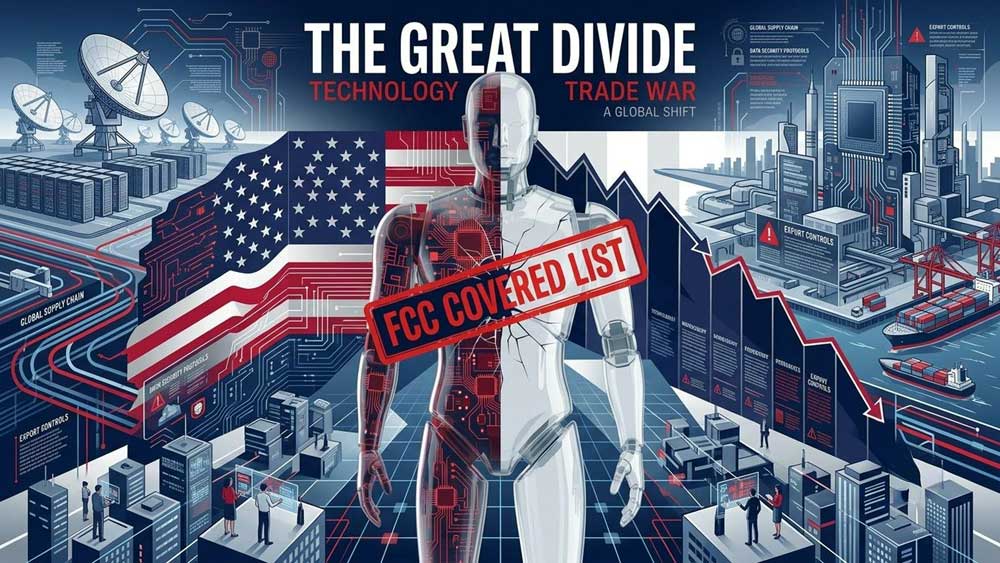
At 2:00 PM Washington time on July 28, 2026, the Federal Communications Commission published Document DA 26-786, a regulatory act that instantly reshaped the global robotics landscape. The Trump administration, acting through the FCC rather than Congress, added "foreign-produced advanced robotic devices" to the Covered List — the roster of equipment deemed too risky to authorize for sale in the United States.
This is not a new law. It is an application of the 2019 Secure and Trusted Communications Networks Act, the same statute that already banned Huawei, ZTE, DJI drones, and Chinese port cranes. But for the first time, the rule extends to robots that walk, run, jump, and physically interact with the world around them.
The trigger was a determination issued by a White House-convened interagency body on July 27, 2026, which concluded that advanced foreign-origin robots pose "unacceptable risks to national security." That determination landed at the FCC's Bureau Chief for Public Safety and Homeland Security at 11:00 AM on July 28. By 2:00 PM, the ban was in effect.
2. What the Rule Actually Says
FCC Document DA 26-786, Appendix C, defines with surgical precision what falls under the ban and what does not.
The Definition of "Advanced Robotic Device"
A device is captured by the ban only if it meets all of the following criteria:
- Autonomous locomotion: Capable of movement, obstacle avoidance, and autonomous navigation in an environment.
- Remote operation: Does not require continuous physical presence of a human operator.
- Weight exceeding 4.4 pounds (~2 kg), including its charging station.
- Connectivity: Features a network connection with speed ≥200 kbps.
- Advanced software: Runs software controlling at least one of the following — autonomous navigation, environmental perception, data collection, or remote command.
This definition explicitly captures humanoid (bipedal) and quadruped (robot dog) platforms, while leaving out several critical categories:
- Fixed industrial arms: Articulated, delta, gantry, SCARA — all excluded because they are not mobile.
- Connected road vehicles: Autonomous vehicles are not covered.
- Medical devices: Surgical robots, prosthetics, motorized wheelchairs.
- Drones: Already regulated separately under the DJI ban.
- Robots under 2 kg: Excluded by weight.
The "Foreign-Produced" Test: Not a "China Ban"
Here lies the most important subtlety. The rule does not say "banned if made in China." It says "banned if foreign-produced." And "foreign-produced" is defined using the Buy American Act test (48 CFR 25.101(a)):
A robot is "foreign-produced" if, even when assembled in the United States, it contains more than 50% of its component value from abroad.
This means:
- A Chinese robot fully assembled in China is banned.
- A Chinese robot assembled in Texas but with 60% Chinese components is banned.
- A Chinese robot assembled in Texas with 75% American components is legal.
- An American robot assembled in China is banned.
The concept is the clear: the ban is manufacturing-based, not nationality-based.
3. Models in the Crosshairs: Who's In and Who's Out
The rule is prospective, not retroactive. This creates a bifurcated market.
The "Grandfathered": Robots That Remain Legal
Models that had already obtained FCC authorization before July 28, 2026, can continue to be imported, sold, owned, and used. According to FCC records, these Chinese models are "saved":
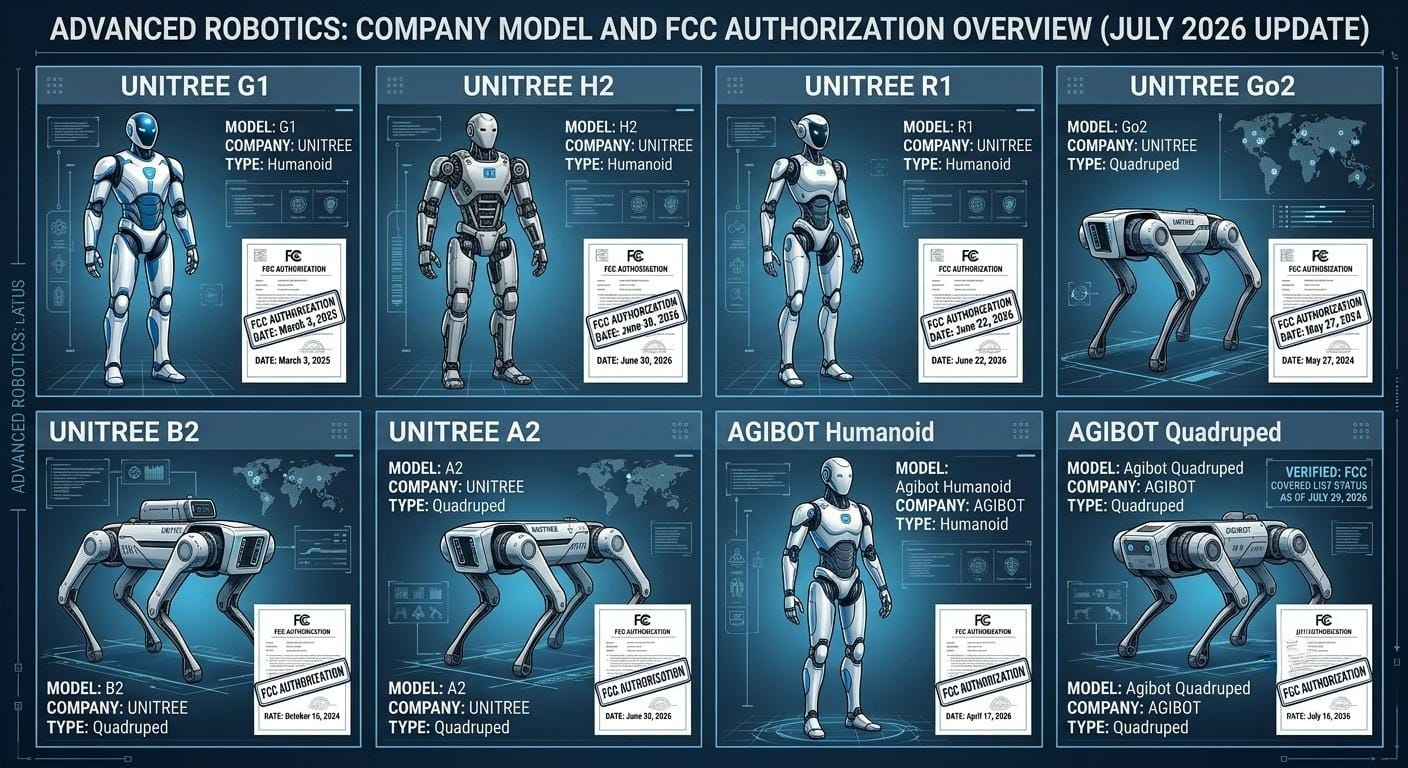
Unitree, in particular, pursued an aggressive FCC certification strategy. Its G1 flagship humanoid, sold at roughly $16,000 (one-third the price of Western competitors), was authorized back in March 2025. The newer H2 and R1 models cleared just days before the ban.
The Blocked: New Arrivals Stopped at the Border
Models that had not completed the FCC authorization process by July 28, 2026, are now blocked unless they obtain a "Conditional Approval":
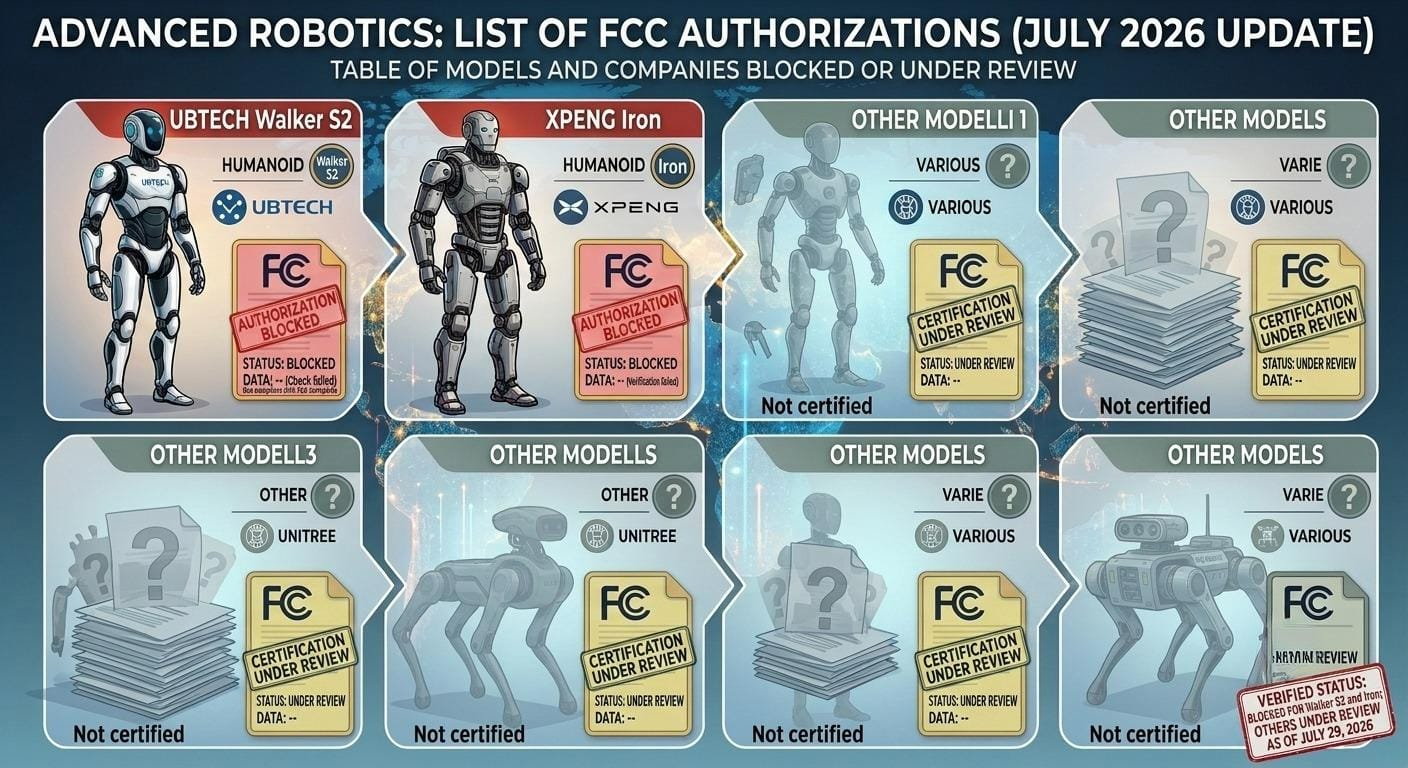
Conditional Approval is a mechanism provided by the rule, but as of this writing, none have been granted for robotic devices. It is administered by the Department of War for robots and by DHS for inverters. To obtain it, a company must demonstrate secure supply chains, verifiable firmware, absence of backdoors, and compliance with national security standards. It is a theoretical pathway, but practically unexplored.
4. Chinese Companies: The Giant in the Crosshairs
Although the rule names no countries or companies, the impact falls almost entirely on China. And this is no accident.
China's Dominance in Humanoid Robotics
According to January 2026 data, Chinese companies represent 6 of the top 10 humanoid robot manufacturers globally and ship 87% of all humanoid robots sold worldwide. Unitree alone holds roughly 20% global market share.
China's competitive advantage is not merely technological — it is economic and structural:
- Subsidized pricing: Unitree's G1 sells for ~$16,000. Western competitors — Figure AI, Agility Robotics, 1X Technologies — sell comparable models for $50,000 or more. This price gap is "achievable only through state subsidy," as analysts have noted. No American or European manufacturer can match this without equivalent state support.
- Integrated supply chain: China controls much of the production of critical components — actuators, force sensors, high-density batteries, control circuits.
- Military-Civil Fusion: The most delicate node. Unitree, in particular, admitted in exchange filings to having received funding from Chinese military (PLA) research. This link between civilian industry and the military-industrial complex is at the heart of American national security concerns.
The Companies in Detail
Unitree is the most exposed name. Originally founded as a drone and quadruped manufacturer, it became the global leader in low-cost humanoid robots. Its aggressive FCC certification strategy allowed it to "save" its key models, but future developments — new versions, hardware upgrades — could be blocked unless Conditional Approval is obtained.
UBTech is another significant presence. Its Walker robot is already deployed in US enterprise facilities. The blocking of Walker S2 represents a direct blow to its American expansion.
Agibot, Engine AI, Fourier Intelligence, and Robot Era are other emerging Chinese players that must now rethink their US market entry strategy.
5. Implications for American Industry: Golden Window or Trap?
The ban creates a paradoxical situation: it protects American robotics from cut-price Chinese competition, but exposes the same industry to risks from a supply chain still dependent on foreign inputs.
Potential Beneficiaries
American companies that could benefit from the protection include:
- Figure AI: California-based startup with an "AI-first" approach to humanoid robotics, already partnered with BMW and other major industrials.
- Agility Robotics: Known for the Digit robot, focused on logistics and warehouse automation.
- 1X Technologies: Norwegian-American startup with strong backing from OpenAI.
- Tesla (Optimus): Elon Musk has massive ambitions in the sector, but mass production remains distant.
- Apptronik: Collaborates with NASA and develops humanoid robots for space and terrestrial applications.
- Ghost Robotics: Specializes in military and security quadrupeds, and could benefit from protection in the defense sector.
These companies now have a "protected window" to develop domestic supply chains, raise capital, and reach production scale without having to compete directly against state-subsidized prices.
The Supply Chain Problem
But there is a fundamental issue: the American robotics industry does not yet have a mature domestic supply chain. Many critical components — high-precision force sensors, linear actuators, high-density lithium-ion batteries, motor magnets, control circuits — still come from China, South Korea, Japan, or Taiwan.
If the ban were extended "further down the value chain" — to the components themselves — American companies would struggle to produce their own robots. The current rule applies to finished robots, not components. But if the ban's logic were extended, the entire sector could slow down.
Moreover, there is the risk of Chinese retaliation. Beijing could respond with restrictions on exports of critical materials — rare earths, neodymium magnets, specialized electronic components — on which the American robotics industry depends. Analysts have already invoked the rare earth scenario: in the past, China has used mineral export restrictions as a commercial weapon.
6. The National Security Rationale
The White House and FCC have articulated three lines of concern:
1. Cybersecurity and Remote Takeover
Advanced robots are essentially network endpoints that walk. They carry cameras, microphones, LiDAR sensors, WiFi/5G connections, and the ability to move autonomously through physical spaces. If compromised by a hostile actor, they could be used for:
- Physical surveillance of critical infrastructure
- Theft of sensitive data
- Remotely commandeering the robots themselves and using them for sabotage or physical attacks
The interagency determination concluded that foreign-built robots "create a cybersecurity risk that threatens the security of critical infrastructure and the safety and security of US residents."
2. Supply Chain and Disruption
Dependence on foreign hardware creates a strategic vulnerability. In the event of geopolitical escalation, China could interrupt the supply of robots or components, paralyzing sectors that depend on these technologies.
3. Military-Civil Fusion
The link between Chinese robotics companies and the People's Liberation Army (PLA) is documented. Unitree admitted to PLA research funding in exchange filings. The American logic is that every dollar spent on a Chinese robot could indirectly support the military capabilities of a potential adversary.
7. Geopolitical and Industry Reactions
China: "Defamation" and Threats of Retaliation
The Chinese embassy in Washington reacted harshly, calling the ban "defamation" and threatening "all necessary measures" in response to any action causing material harm to Chinese interests. China has previously used restrictions on critical minerals and technology exports as commercial retaliation tools.
The FCC: "In Lock Step with Our National Security Agencies"
FCC Chairman Brendan Carr defended the measure, stating that the agency acts "in lock step with our national security agencies." The FCC presents itself as the technical executor of a broader national security strategy, not as an independent initiator of trade policy.
American Industry: Opportunity but Also Uncertainty
American robotics startups view the ban with mixed feelings. On one hand, protection from Chinese price dumping is a relief. On the other, uncertainty about components and the risk of Chinese retaliation creates anxiety. Moreover, some operators fear that protection could reduce competitive pressure, slowing innovation.
Universities and Research Labs
The ban does not affect robots already purchased. Universities and R&D labs that already own Unitree G1, Go2, or other certified models can continue using them without restriction. But they will no longer be able to purchase new unauthorized models. This could slow research that depends on access to the latest hardware, or push institutions toward American suppliers — which cost more and are less available.
8. The Strategic Dilemma: Shock Therapy or Boomerang?
The July 28 ban poses a fundamental question: does market protection accelerate domestic industry or paralyze it?
The Pro Case: Reshoring and Technological Sovereignty
Supporters argue that without protection, American robotics startups would be wiped out before reaching production scale. China aggressively subsidizes the sector, creating artificially low prices that no private competitor can match. The ban is therefore a "nursing" measure — protecting a nascent industry until it is strong enough to compete.
Moreover, robotics is considered critical infrastructure for the future. Allowing a potential geopolitical adversary to control that infrastructure is seen as an unacceptable risk, analogous to the challenges already faced with 5G networks (Huawei) and drones (DJI).
The Con Case: Dependency and Retaliation
Critics point out that the American robotics industry is still too dependent on Asian supply chains to fully benefit from the ban. Without domestic components, American companies might simply fail to produce enough robots to meet demand, creating a shortage that slows robotics adoption across all sectors.
Furthermore, Chinese retaliation on critical materials could hit not only robotics but adjacent sectors — consumer electronics, automotive, renewable energy — creating a net economic damage greater than the benefit of protection.
The Third Way: Conditional Approval and Verification
The rule leaves a door open: Conditional Approval. If Chinese (or other foreign) companies were willing to:
- Open factories in the US
- Source 75%+ of components domestically
- Submit firmware and software to security verification
- Demonstrate absence of backdoors and military links
they could theoretically obtain an exemption. But no Conditional Approvals have been issued to date, and the process is opaque and potentially political.
9. What Happens Next? A Probabilistic Timeline
Immediate (August 2026): Grandfathered models remain on the market. Blocked models cannot enter the US. Chinese companies evaluate whether to invest in American factories or abandon the market.
Short term (end of 2026): Lawsuits will likely arrive. Chinese companies may challenge the ban before the DC Circuit Court of Appeals, arguing that the FCC exceeded its authority or that the "foreign-produced" definition is too vague.
Medium term (2027): If China responds with restrictions on critical materials, the entire American tech industry will feel the blow. Conversely, if American startups manage to scale domestic production, the ban may be seen as the catalyst for a homegrown robotics industry.
Long term (2028+): The ban could be extended — to components, software, or even fixed industrial arms (currently exempt). Or it could be softened if geopolitics shifts or if American industry reaches self-sufficiency.
10. Conclusion: Robotics Is No Longer Just Technology
July 28, 2026, marks a dividing line. Before that day, robotics was primarily a technological and commercial sector. After, it became a geopolitical battlefield.
The Trump administration has bet that it is better to pay a short-term price — supply chain shortages, retaliation risk, higher costs for consumers and researchers — to ensure that the physical infrastructure of the future is not controlled by a potential adversary.
But it is a high-risk bet. If American industry fails to close the technological and production gap quickly, the ban risks transforming from protection into handicap. If, instead, American startups — Figure, Agility, 1X, Tesla, Apptronik, Ghost — manage to scale, July 28, 2026, may be remembered as the day the American robotics industry was born.
In the meantime, those who already have a Unitree G1 on their workbench can breathe a sigh of relief. Those waiting for the Walker S2 will have to wait much longer — or forever.