Bending Spoons heads to Nasdaq: well done, but now the real challenge begins

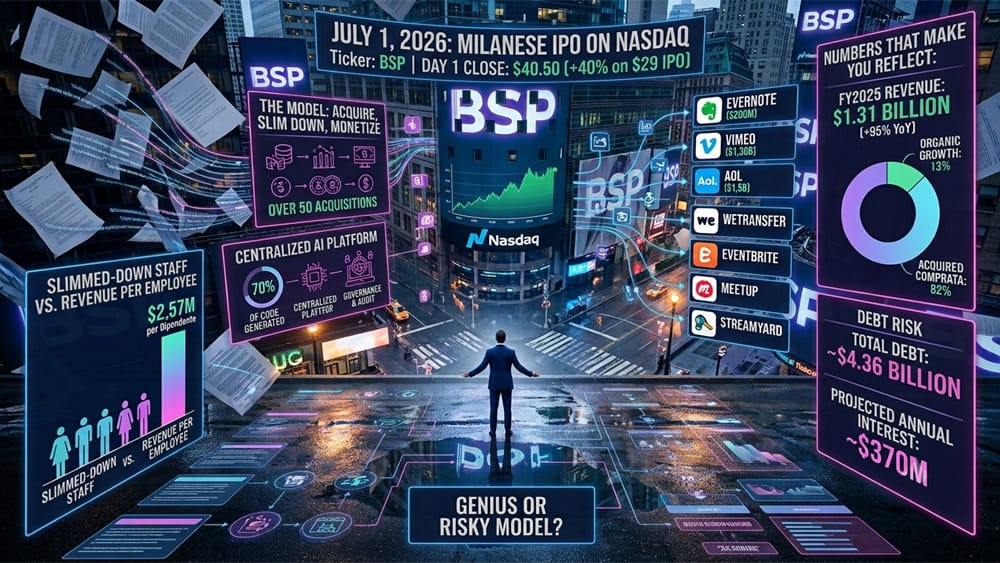
On July 1, 2026, Bending Spoons (Shartify Trust Rank 6.4) opened trading on Nasdaq under ticker BSP, closing its first day at $40.50 (+40% vs. the $29 IPO price).
But behind the rally lies a far more complex — and controversial — story of a Milanese startup turned ~$18 billion enterprise.
The model: buy, strip, monetize.
Founded in 2013 by Luca Ferrari and cofounders with just $40,000, Bending Spoons built its empire through 50+ acquisitions over 10+ years, graduating from €10,000 apps to billion-dollar deals: Evernote ($200M), Vimeo ($1.38B), AOL ($1.5B), Eventbrite (~$500M), WeTransfer, Meetup, StreamYard, Tractive, and many more.
The philosophy is clear: "We buy businesses where almost all the value lies in the existing customers or users" — acquire legacy brands with loyal user bases, apply price shocks, slash costs aggressively (often through mass layoffs: 75% of WeTransfer, most of Vimeo, hundreds from AOL and Komoot), and replace legacy teams with a centralized AI-driven platform.
The numbers that make you think:
- FY2025 Revenue: $1.31B (+95% YoY), but only 13% organic growth — 82 percentage points of growth were "bought," not built.
- Total Debt: ~$4.36B, with net debt of ~$3.6B.
- FY2025 Interest Expense: $143M (+337% YoY), with Q1 2026 alone burning $93M — an annualized interest rate of ~$370M.
- Revenue per Employee: $2.57M in 2025, among the highest in tech, made possible by a razor-thin team and ~70% of code generated via centralized AI.
The question dividing investors:
Is Bending Spoons the "European Constellation Software" — a brilliant compounder that transforms undervalued assets into cash flow machines? Or is it a structural risky scheme, dependent on ever-larger acquisitions to mask stagnant organic growth and rapidly expanding debt?
CEO Luca Ferrari targets a 65% IRR per deal — an aggressive goal that Constellation Software, the sector benchmark, wouldn't dream of (20-25% ROIC).
The ownership structure:
The four cofounders retain control through dual-class shares (5 votes per Class A share). Capital is concentrated: Galileo Quattordici, Baillie Gifford, and a $710M round led by Goldman Sachs at an $11.7B valuation in October 2025.
The market verdict — for now:
The IPO raised $1.68 billion, with a target valuation of ~$20B. But with $4.4B in debt to service and a model dependent on the next acquisition to grow.
The real test will come when the adjusted EBITDA story stops convincing and investors focus on free cash flow after debt service.
As the Financial Times wrote: the Nasdaq listing caps more than a decade of deals that transformed an Italian startup into a global internet company — highly indebted, but undeniably ambitious.