
Goodbye, Football: Italy Without the World Cup and Without Professional Soccer?
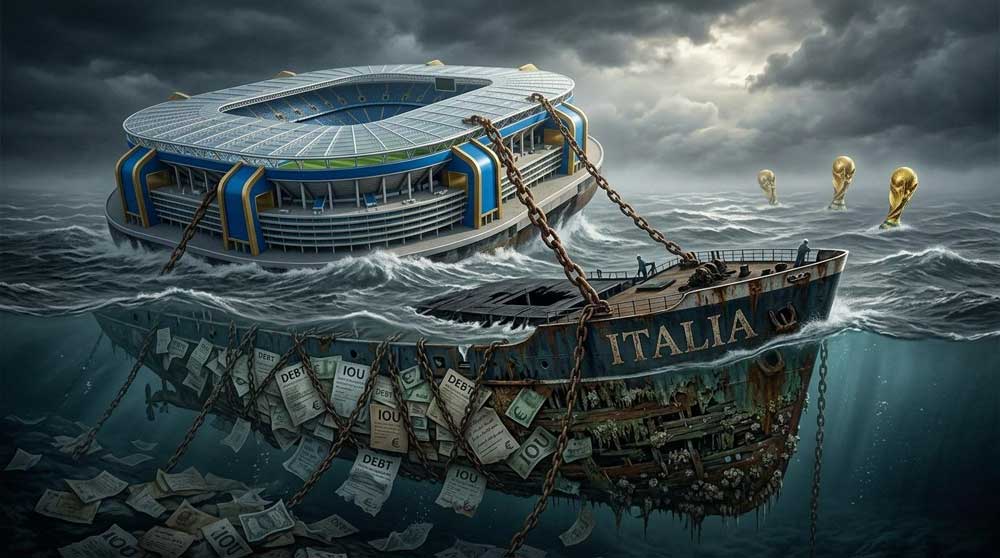
An unfiltered scenario after last night's disaster
Last night Italy hit rock bottom. Again. The defeat to Bosnia sealed our absence from the 2026 USA/Mexico World Cup: the third consecutive time the Azzurri will watch the planet's most prestigious tournament on television. First 2018 in Russia, then 2022 in Qatar, now 2026 in North America. Three absences out of four editions.
 albertofattori
A catastrophe without precedent for a nation that has football in its DNA.But today, in the anger of the morning after, we ask: what if Italian professional football simply disappeared? Not a temporary suspension, not a reform. Canceled. Shut down. End of transmission.A blasphemous thought? Perhaps. But after last night, perhaps also liberating.
The bill: how much does this national disaster really weigh?
Italian professional football is a colossus with feet of clay. It generates €12.4 billion in GDP and supports 141,000 jobs — numbers that impress until you look behind the curtain: €5.5 billion in debt, €9.3 billion in cumulative losses over 17 years, and 80% of clubs closing their books in the red every season.It is a sector living on disguised public subsidies called "investments," on fictitious capital gains from player trading, on inflated TV rights from foreign speculators. Over 27 of 99 clubs are American-owned — not because they love calcio culture, but because they sniffed out a market to exploit like a private equity firm.And the result? Three missed World Cups, football increasingly distant from ordinary people, stadiums that empty fans' pockets while players earn astronaut salaries only to lose against teams that until yesterday were considered cannon fodder.
The apocalyptic scenario: tomorrow, no more Serie A
Imagine waking up tomorrow and reading that the FIGC has declared bankruptcy, that professional clubs are closing their doors, that there will be no more championship. Panic? Liberation? Let's analyze the consequences without flattery.
The immediate collapse: €5.2 billion in GDP that evaporates
The professional sector generates €5.2 billion in direct production. Club revenues, player salaries, sponsorship contracts — all gone. But this is just the beginning.Football tourism: €1.3 billion up in smoke. Milan, Turin, Rome, Naples — cities that also live off fans filling hotels, restaurants, shops. 25% of stadium spectators are foreigners. Without matches, these flows dry up. Bars near stadiums? Half would close within six months.Betting: €16 billion in revenue at risk. Football represents 75% of sports betting in Italy, with €400 million in annual tax revenue for the state. Without matches to bet on, the entire betting sector collapsapses — and with it thousands of jobs in betting shops, online platforms, and state monopolies.Media: €1.2 billion in vanished audience. 710 million global Serie A fans, 470 million TV viewers in Italy. Sports channels losing their reason to exist, newspapers closing their sports desks, websites laying off staff. The Italian media ecosystem is built on football like a cathedral on its foundation.
Tax revenue: €20 billion in 17 years, gone
Football is the largest tax contributor in Italian sport: over 70% of all sports tax revenue. Twenty billion paid over 17 years. Without professional football, the state immediately loses over €1 billion annually in taxes, contributions, and betting levies.And the paradox? For every euro "invested" by the government in football, the state receives 20.5 back in tax revenue. A return on investment that few other sectors can boast — even if this "investment" is often merely a transfer of public resources to chronically loss-making private companies.
The uncomfortable truth: football is irreplaceable, but also unsustainable
After last night, every Italian fan has the right to hate this sport. Three consecutive World Cup absences are not a bump in the road: they are proof of a failed system. A football that produces €9.3 billion in losses over two decades, that accumulates €5.5 billion in debt, that lives on foreign capital that could flee tomorrow, cannot call itself a "healthy industry."And yet, canceling it would be economic suicide. Not for the €5.2 billion direct impact, but for the induced effects — that fabric of economic activities living around the ball without being football itself. The fan's tavern, the away team's hotel, the sports journalist, the betting call center operator, the waiter serving the team at their training retreat. These are hundreds of thousands of lives that have nothing to do with last night's result, but depend on that idiotic game of 22 men in shorts.
The heretical proposal: not cancel, but restart
If Italian professional football were canceled tomorrow, Italy would emerge economically devastated but morally liberated. Because the real problem isn't football itself, but the model that transformed it from popular passion to speculative machine.The solution isn't closure, but radical reconstruction:
- Real salary cap: no more million-euro contracts for players who can't score from a standstill
- Fan ownership of clubs: end of foreign speculation, return of football to communities
- Investment in youth: stop buying foreign talent and valorize the Italian academy system
- Fiscal transparency: no more fictitious capital gains or opaque bond loans
- Reduction in number of teams: 20 in Serie A are too many for a system that can't sustain them
Conclusion: Did Bosnia do us a favor?
Last night, in the most humiliating defeat in years, perhaps Bosnia gave us something precious: definitive proof that the system is broken. We don't need another superficial reform, another exotic coach, another debt restructuring plan.We need to admit that Italian professional football is a dinosaur — a prehistoric colossus that generates wealth for few and despair for many, that spits out billions in GDP but swallows billions in debt, that promises glory and delivers humiliating eliminations.But cancel it? No. Because those 141,000 jobs, those €12.4 billion in GDP, those €20 billion in tax revenue are real people, not numbers on a spreadsheet. People who don't deserve to lose their jobs because the FIGC can't govern and clubs can't do business.Italy cannot do without football. But Italian football, as it is, cannot continue to exist. After last night, after the third consecutive World Cup absence, perhaps it's time to stop pretending everything is fine.The ball must change. Or the ball will end up changing Italy — and not for the better.